
The European markets, including major indices like the FTSE 100 and Germany 40, ended the June quarter with positive gains. Both showed resilience despite ongoing trade and economic concerns. Although the overnight session closed weaker due to profit-taking and mixed macro data, these markets still posted solid quarterly performances.
The FTSE 100 rose by 2.08% in the quarter. Meanwhile, the Germany 40 (DAX) delivered a stronger 7.88% return. While these figures are more modest than those of US indices, they mark a notable rebound from early April lows. This performance offers renewed optimism to European investors amid persistent headwinds.
Much of the recent market volatility stems from weak German economic data. Retail sales dropped sharply, and inflation figures softened. Combined with uncertainty over global tariffs—especially around the 9 July expiry of certain US trade measures—investors have remained cautious.
Adding to the mixed backdrop, recent announcements suggest some improvement in transatlantic trade ties. The UK and US agreed on a new trade deal aiming to reduce or eliminate tariffs on key sectors like automobiles and aerospace. This could support medium-term sentiment. However, not all barriers have been removed, and global trade dynamics remain fluid.
Key Macro Updates Affecting European Markets
Eurozone inflation figures for June are due soon and will be closely watched. Analysts expect a slight uptick in headline inflation to 2% year-on-year. Core inflation is forecast to remain at 2.3%. These readings will guide expectations for further ECB rate moves in the second half of the year. Markets currently price in another 25 basis point cut by December.
Q2 Performance Comparison of European Markets
Here’s how major indices performed in Q2 2025:
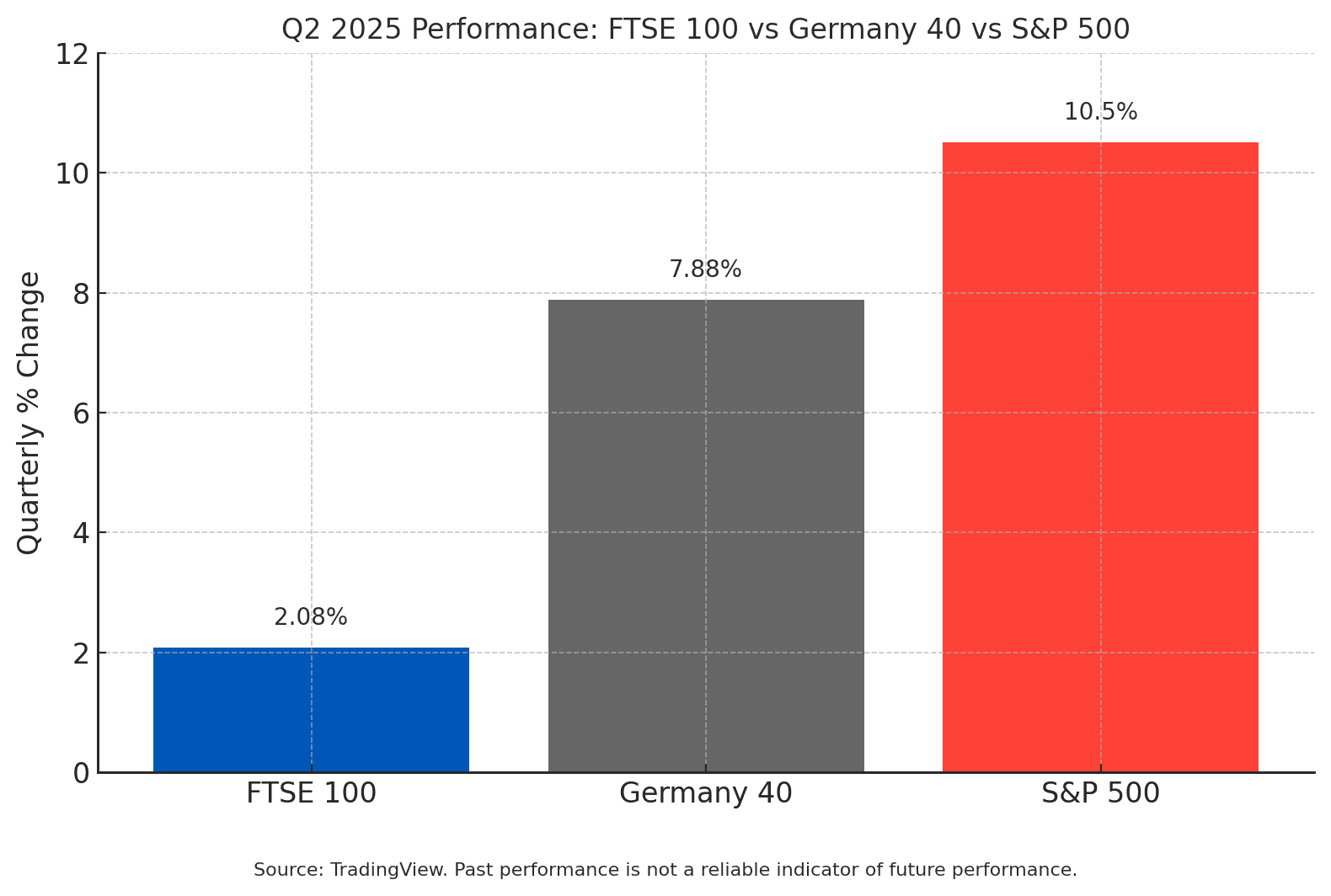
Source: TradingView. Past performance is not a reliable indicator of future performance.
FTSE 100 outlook
The FTSE rebounded sharply from April’s low of 7544 after a 1364-point drop from March’s record high. Recent price action suggests consolidation below the 8900 level. A break below the 8700–8710 support range may signal a potential double top formation. However, a sustained hold above this range could trigger a retest of all-time highs. Watch for technical support near the 200-day moving average, around 8448, if weakness continues.
Germany 40 Outlook Amid European Market Trends
Germany’s benchmark index climbed above a key resistance level of 23,746 in May and reached a record 24,479 in early June. Since then, the index has been consolidating. A pullback into the 23,000–22,500 region would likely be a healthy correction rather than a trend reversal. Bulls may view this zone as a good opportunity to re-enter heading into the second half of the year.
Despite macroeconomic uncertainties, both the FTSE and Germany 40 remain technically strong. They are supported by cooling inflation and evolving trade dynamics. The coming weeks will be pivotal as markets digest inflation data, central bank guidance, and global trade developments.
Source: TradingView. Figures accurate as of 1 July 2025. This article does not contain financial advice or recommendations.