
Ether outpaces Bitcoin this week, and the move has revived an old debate: are institutions meaningfully rotating toward Ethereum, or is this just a burst of momentum inside a broader crypto rally? Below is a balanced look at the drivers, the caveats, and what could keep (or cap) ETH’s relative strength.
1) Fund Flows: A Clear Pulse
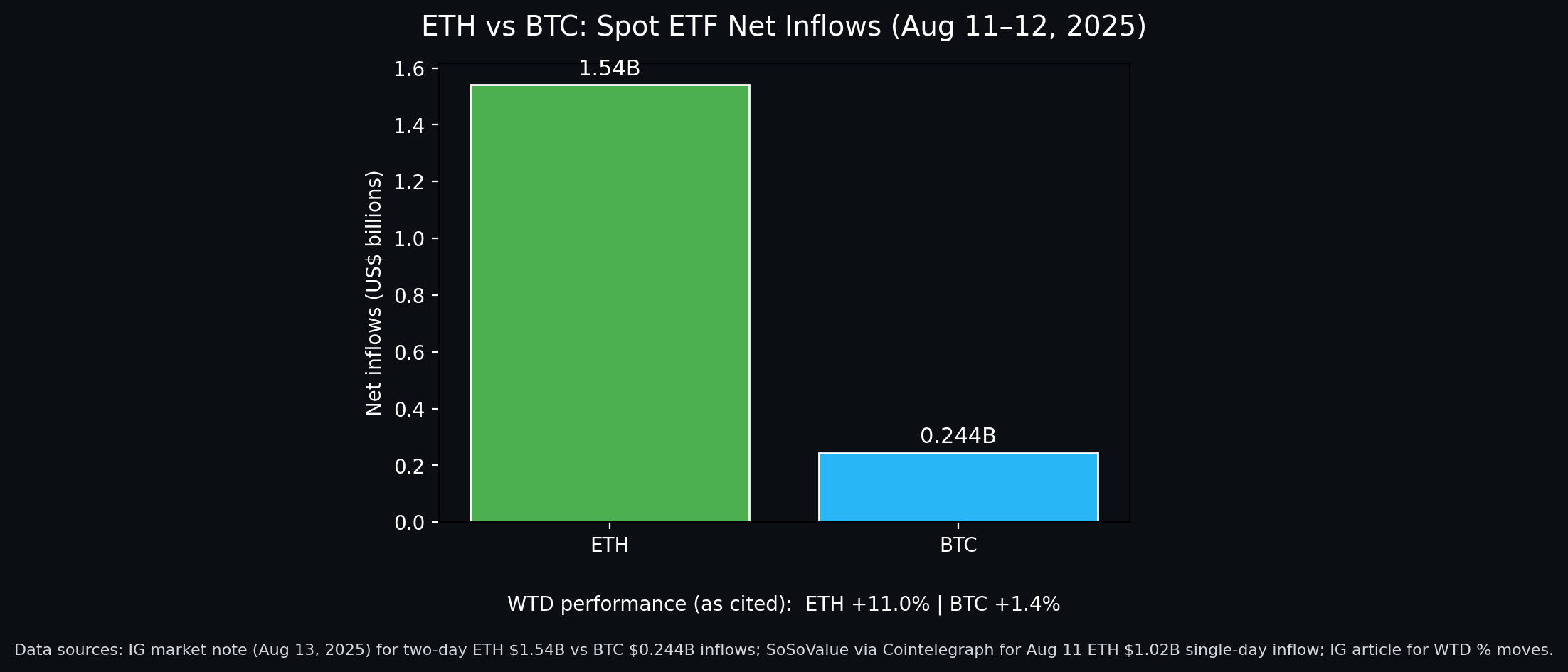
Spot ETFs provide the cleanest read on institutional demand. Recent sessions saw unusually strong net inflows into spot ether products while spot bitcoin flows were more modest. Flow surges often coincide with relative price outperformance, but they can also reverse quickly when the tape turns. Treat flow spikes as evidence of interest, not a guarantee of trend persistence. View current ETH vs BTC charts.
2) Network Upgrades: Why Ether Outpaces Bitcoin
Ethereum’s upgrade cadence continues to influence positioning. The Dencun hard fork introduced blob transactions (EIP-4844) to reduce data costs for rollups, supporting Layer-2 economics. More recently, the Pectra upgrade advanced wallet UX and validator operations, with account-abstraction features (such as those associated with EIP-7702) cited as potential on-ramps for mainstream users and enterprises. Together, these improvements underpin the view that Ethereum’s stack is converging on lower costs, smoother UX, and sturdier infrastructure—factors institutions weigh when allocating. Learn more about Ethereum upgrades.
3) Tokenisation & Institutional Infrastructure
Beyond ETFs, the tokenisation of traditional assets on public chains—frequently on Ethereum—has expanded. Large issuers and service providers have launched tokenised funds and tooling, normalising workflows like issuance, custody, and transfer. While the market is still small relative to traditional finance, the direction of travel supports a thesis that Ethereum’s settlement rails may capture more real-world assets over time. BlackRock’s tokenisation initiatives are a notable example.
4) Macro Backdrop Still Matters
Crypto remains sensitive to interest-rate expectations. Softer inflation prints and rising odds of near-term rate cuts typically lower the opportunity cost of holding non-yielding assets, helping beta. This week’s risk-on tone likely amplified flows already favouring ETH’s narrative, but the same macro could just as easily boost BTC on any given day. Federal Reserve policy updates remain a key variable.
5) Market Structure: Spot, Futures, Options
As ETH leads on the tape, positioning often tilts bullish in futures and options. That alignment can support continuation, but it also raises the risk of sharp shakeouts if narratives stall. Watch funding, skew, and liquidity gaps around prior highs to gauge vulnerability.
6) Technical Levels in the Ether vs Bitcoin Battle
Bulls will point to ETH holding above prior breakout areas and probing resistance near historical peaks. Bears will note proximity to supply zones where rallies previously faded. For traders, a simple framework is to respect momentum while it holds, but define invalidation levels below recent higher-lows to manage risk.
Risks That Could Reverse Ether’s Lead Over Bitcoin
- Flow fatigue: ETF demand cools or reverses.
- Upgrade reality check: post-upgrade UX or security trade-offs disappoint, or enterprise adoption lags.
- Macro shock: yields reprice higher, tightening financial conditions.
- Regulatory drift: policy uncertainty curbs institutional participation.
Bottom Line: Can Ether Keep Outpacing Bitcoin?
Ether’s edge over Bitcoin this week looks anchored in three pillars: stronger spot ETF flows, credible network upgrades, and steady progress in tokenisation infrastructure—on top of a cooperative macro backdrop. That said, leadership in crypto is cyclical. If flows ebb or macro tailwinds fade, relative strength can flip quickly. For allocators, the prudent approach is to separate structural thesis (Ethereum’s evolving functionality and enterprise fit) from tactical execution (position sizing, risk limits, and clear invalidation levels).