
Why both the dollar and gold matter right now
The dollar and gold often move for different reasons. Both reflect how markets price risk, growth and monetary conditions. This piece looks at why the dollar may stabilise after a long slide and why gold trades at record real levels. It is written as an impartial market note, using recent price action, flows and policy signals.
Dollar: from a one-way trade to possible base-building
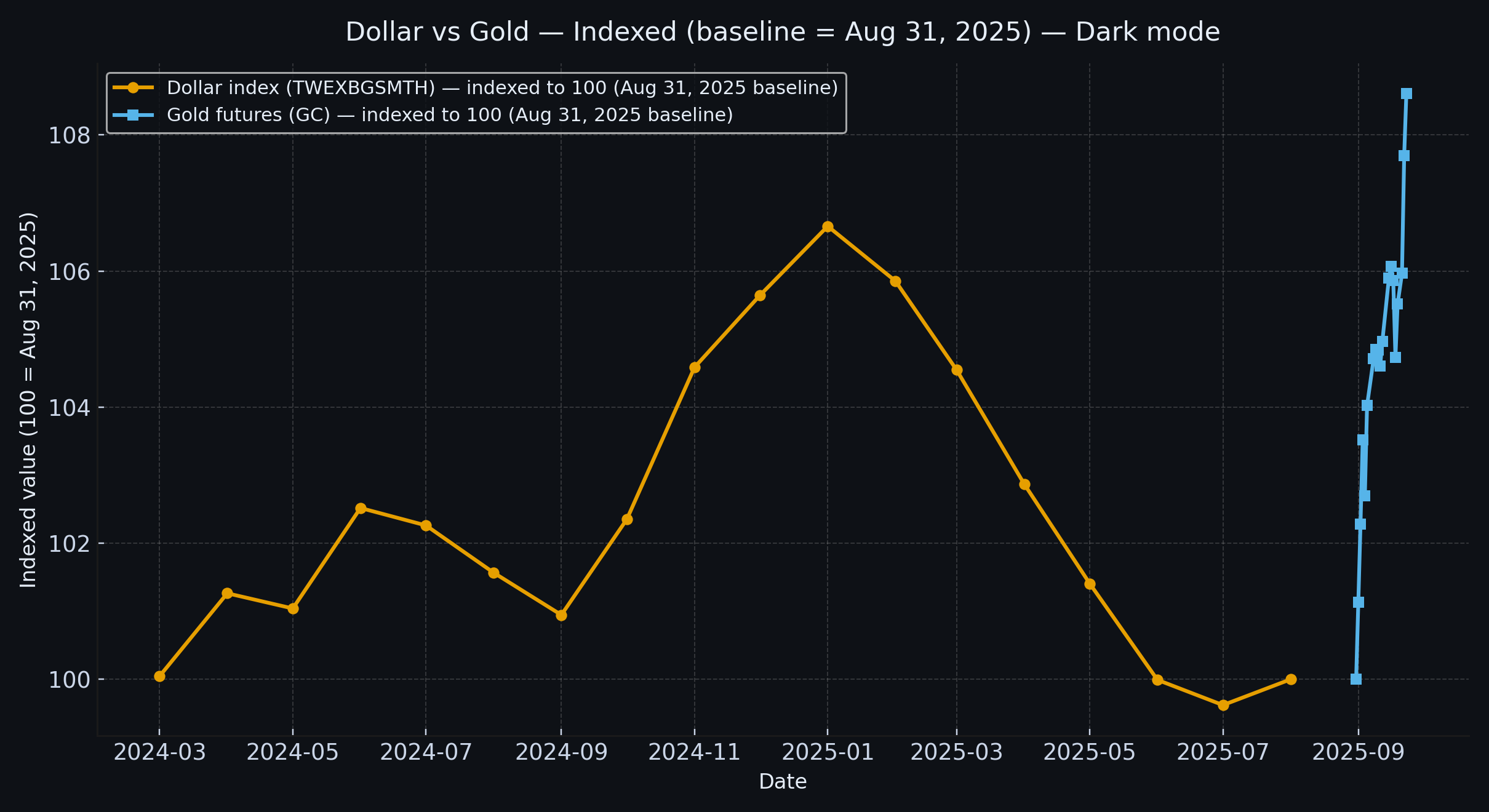
The dollar weakened for much of this year. Recently, however, price action shows signs of consolidation instead of another sharp decline. Part of this reflects a calmer trade-policy backdrop and steadier global growth. These changes reduced the one-way flow away from dollar assets. Shifts in monetary expectations also matter. If central banks diverge again, dollar demand can return quickly. IMF on FX dynamics
Underlying fundamentals still support the US economy. Consumer spending has been resilient, while business investment has remained firm. These strengths allow the economy to absorb shocks more easily than markets sometimes expect. Political and fiscal developments also play a role. A deep US capital market and relatively attractive yields can act as a counterweight to earlier outflows. Bloomberg FX coverage
Gold: record real price and the outsized effect of flows
Gold’s role as a store of value grows when real rates fall and currencies weaken. Inflows into gold ETFs and central bank purchases magnify price moves. The gold market is small compared with global financial assets. As a result, even modest reallocations create sharp price effects. World Gold Council
From a technical perspective, gold broke out after months of consolidation. That move attracted momentum traders and algorithms, which added further fuel. The same concentration of flows also makes gold vulnerable. A shift in sentiment or a rise in real yields could trigger a quick pullback. Reuters commodities
Dollar and gold: How to think about the relationship
- Rates and real yields: gold benefits when real yields fall. A turn in rate expectations can support the dollar and weigh on gold.
- Flows vs fundamentals: ETF and central bank flows move gold quickly. Dollar moves often depend on policy, political risk and growth gaps.
- Event risk: trade deals, fiscal packages or elections can shift pricing in both assets.
- Positioning: crowded trades raise the odds of sharp, short-lived corrections.
What to watch next for the dollar and gold
Key signals to monitor include real US yields, ETF flows into and out of gold, policy divergence between major central banks, and reserve purchases. If dollar weakness continues to fade while gold flows stay strong, markets may settle into a more balanced outlook. Financial Times markets
Bottom line
Neither the dollar nor gold is driven by a single factor. Right now, the dollar looks to be forming a base, while gold holds near record real prices. Both assets are shaped by flows, yields and policy signals. Market participants should keep a close eye on yields, positioning and cross-asset flows to understand where momentum will head next.