
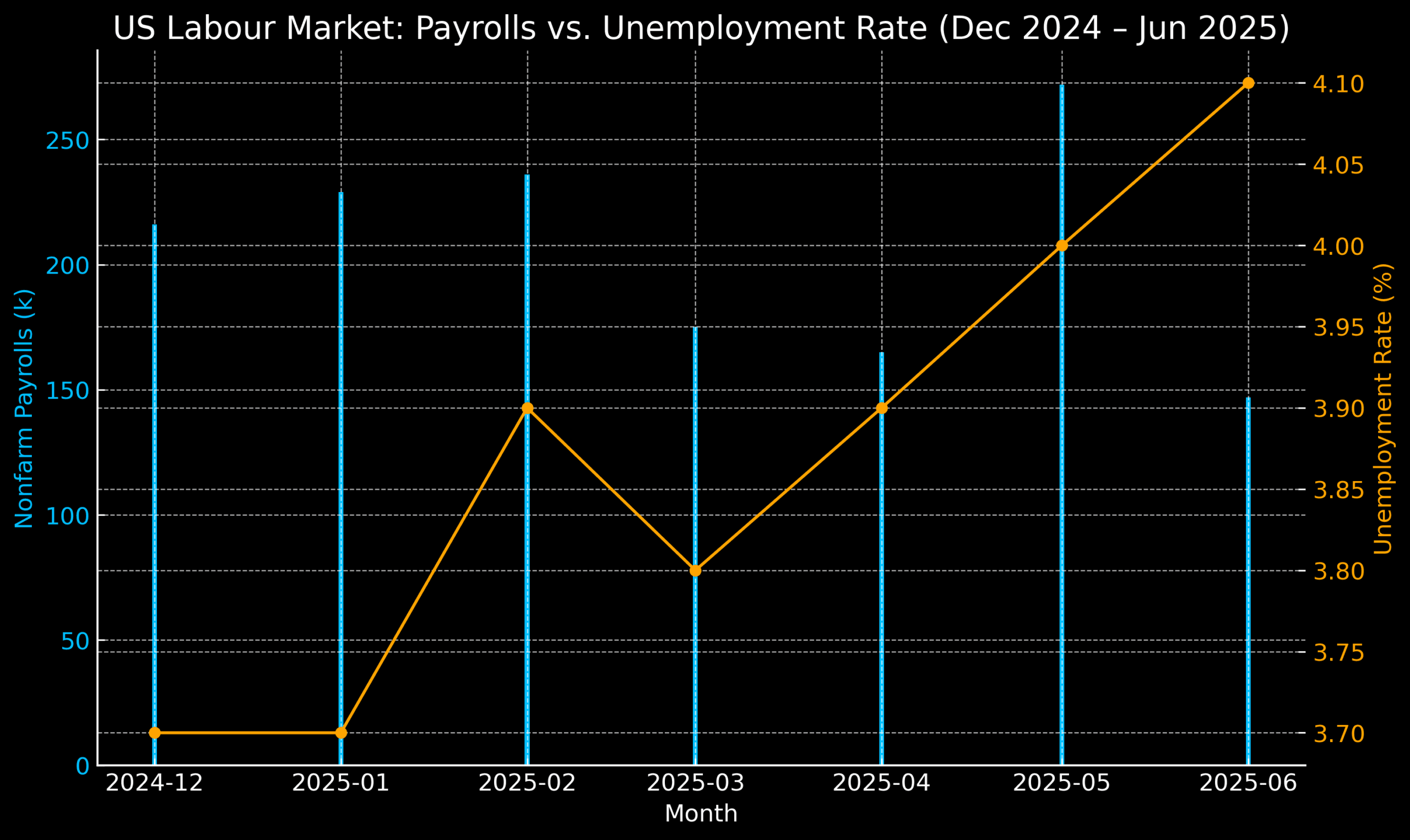
June US jobs data revealed a labour market that remains resilient despite economic uncertainty, with headline nonfarm payrolls rising by 147,000. This comfortably topped forecasts for a 105,000 increase, despite remaining within a tight estimate range. Importantly, upward revisions to previous months added a net 16,000 jobs, pushing the three-month average to 150,000—well above the breakeven level needed to absorb new labour market entrants.
Job creation was broad-based but notably led by state and local government hiring. Manufacturing jobs declined for the second consecutive month, while the professional and business services sector posted its first net loss since March. These mixed signals highlight a labour market that remains active but is beginning to show signs of sector-specific cooling.
June US jobs data also pointed to a moderation in wage growth. Average hourly earnings rose by 0.2% on the month, bringing the annual increase to 3.7%. These figures landed just below expectations, indicating that wage pressures—often a driver of inflation—remain contained for now.
In the separate household survey, the unemployment rate dipped unexpectedly to 4.1%. However, this drop came alongside a fall in labour force participation to 62.3%, the lowest level of the cycle. Analysts suggest that heightened immigration enforcement may have played a role in this decline, though survey volatility remains a factor, as response rates continue to fall.
Markets reacted swiftly. Odds of a July interest rate cut, once seen as a one-in-four chance, were slashed. Traders are now pricing in just 50 basis points of easing for the rest of the year, with the next likely cut postponed to October or beyond.
For policymakers at the Federal Reserve, the June data offers little urgency to act. Barring a resurgence in inflation—possibly triggered by trade-related costs—the Fed seems poised to maintain its current stance. While cuts remain on the table, they are far from guaranteed. The upcoming Jackson Hole Symposium may offer the first real signal of any shift in policy tone.
Chart: US Labour Market Trends (Dec 2024 – Jun 2025)
Data source: US Bureau of Labor Statistics via FRED