
PCE in Focus: what markets are watching
US PCE data is again centre stage for investors: the Personal Consumption Expenditures (PCE) price index is the Fed’s preferred inflation gauge and will be read as a direct test of whether the central bank can pivot toward easing without reigniting price pressures. The coming print matters less as a single number and more as a signal about momentum in core inflation and how persistent tariff-related passthroughs appear to be.
Powell’s recent remarks at Jackson Hole shifted emphasis toward employment risks and suggested that the Fed is prepared to tolerate a temporary uptick in inflation if labour-market weakness grows, increasing the market’s appetite for an early rate cut. You can read Powell’s comments in context from the Federal Reserve’s official speech transcripts.
What to look for in the PCE release
- Core PCE (ex-food and energy): market consensus points to a modest rise, and how close the figure comes to the 3.0% handle will shape sentiment.
- Monthly momentum: a slowing month-to-month pace would be more reassuring than a year-on-year snapshot that moves within a narrow band.
- Services vs. goods: tariffs and goods-price passthroughs lift goods inflation more quickly; persistent services inflation is harder for policy to ignore.
Market pricing around a September cut tightened after Jackson Hole; traders are now attaching materially higher odds to a cut, meaning the data has become the key hurdle between today’s price action and policy easing.
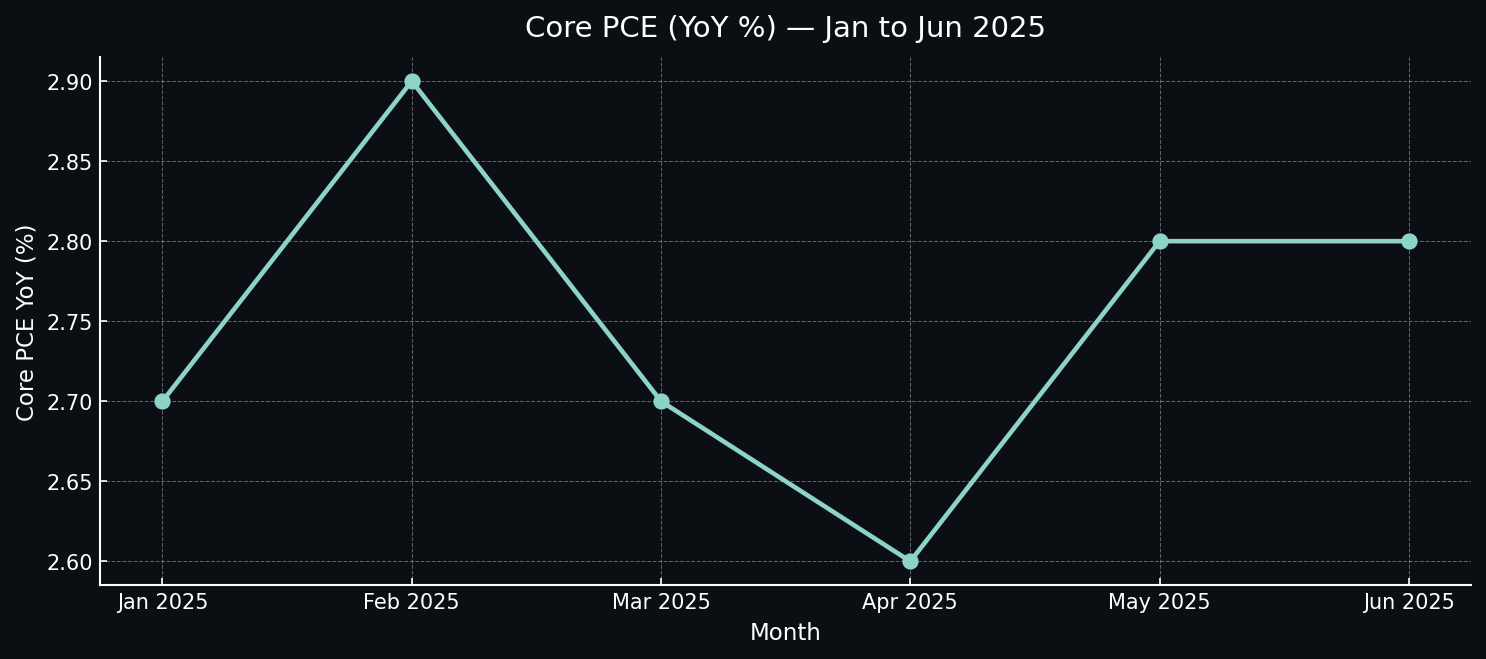
U.S. Bureau of Economic Analysis (BEA) /
FRED (St. Louis Fed).
How markets may react — neutral scenarios
An outcome in line with expectations would likely reinforce the view that the Fed can begin easing while inflation gently drifts toward a higher-but-still-manageable level. That outcome typically supports risk assets and keeps long-term yields in check unless accompanied by unexpectedly strong labour data. Conversely, an upside surprise that lifts core PCE substantially above expectations could push yields higher and briefly strengthen the dollar as investors reassess the timing of cuts.
Implications for safe havens and commodities
Gold has been carving a narrowing range and technical commentators point to a symmetrical triangle pattern. In a market that has largely priced in easing, a soft PCE print would be consistent with a further push in the yellow metal, while an upside surprise could check recent gains and test nearby support levels. Traders are therefore watching both the print and the tone of any accompanying Fed commentary.
Practical takeaways for traders and investors
Keep the focus on momentum and cross-checks: look at monthly PCE, goods vs services, and how the report aligns with recent labour data. Expect heightened but short-lived volatility if the print surprises. For medium-term positioning, the market’s interpretation of whether inflation is re-accelerating or merely bumping up temporarily will matter more than any single headline number.
Final note: the PCE release is an information event: treat it as a catalyst for recalibration rather than a determinative pivot. Watch the details and the Fed’s subsequent communications to gauge whether a September cut remains the most probable path.