
US crude prices have stabilised near key support levels. Traders are cautious ahead of upcoming US-Russia talks. After notable declines in early August, West Texas Intermediate (WTI) remains just above a critical support point, while Brent crude hovers around $66 per barrel. The market is in a temporary holding pattern as participants await clarity from the talks.
The potential outcomes of the US-Russia discussions could significantly influence oil markets. Eased restrictions or partial sanctions relief on Russian oil could expand global supply. This may put downward pressure on prices. Conversely, an escalation of sanctions, especially targeting major Russian oil buyers, could tighten supply and support higher crude prices in the near term.
Inventory data adds context to the current market stance. The American Petroleum Institute (API) recently reported a 1.5 million-barrel increase in US crude inventories. This suggests possible weakening demand as summer winds down. Although official Energy Information Administration (EIA) figures are pending, the inventory build contributes to muted price movements. Traders remain hesitant to commit large positions until diplomatic clarity emerges.
Market reactions will depend on the talks’ outcomes. A constructive agreement could lead to increased supply expectations. This would likely lower oil prices, especially if accompanied by weaker demand signals. In contrast, a lack of progress or reinforced positions without easing sanctions may keep prices range-bound. Crude could consolidate until the next major macro or geopolitical catalyst appears.
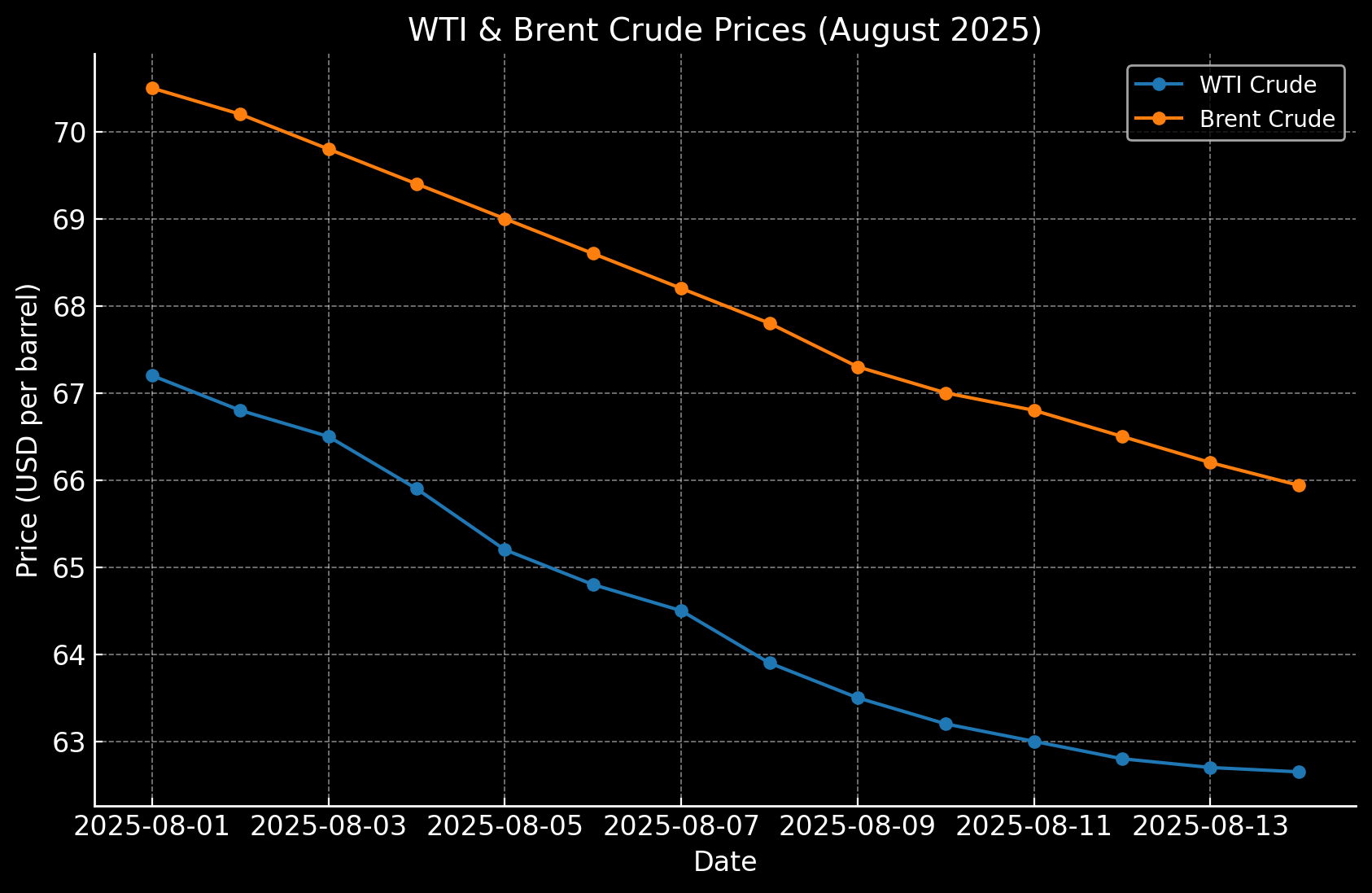
If negotiations break down or result in new sanctions, the oil market could see a rapid rally. Supply concerns would drive this movement. Broader risk sentiment in financial markets could also be affected as investors weigh the implications of heightened geopolitical tension on global trade and energy flows.
Overall, US crude prices remain highly sensitive to geopolitical developments and inventory reports. Traders are monitoring news from the talks closely. Short-term price movements reflect both anticipation of outcomes and underlying supply and demand fundamentals. The coming days may see increased volatility as markets respond to both diplomatic developments and domestic supply data.